
Long words are where reading breaks down. Not because the reader does not know them, but because decoding en·vi·ron·men·tal·ly in one pass is a working-memory problem, and working memory is exactly what is in short supply for readers with dyslexia.
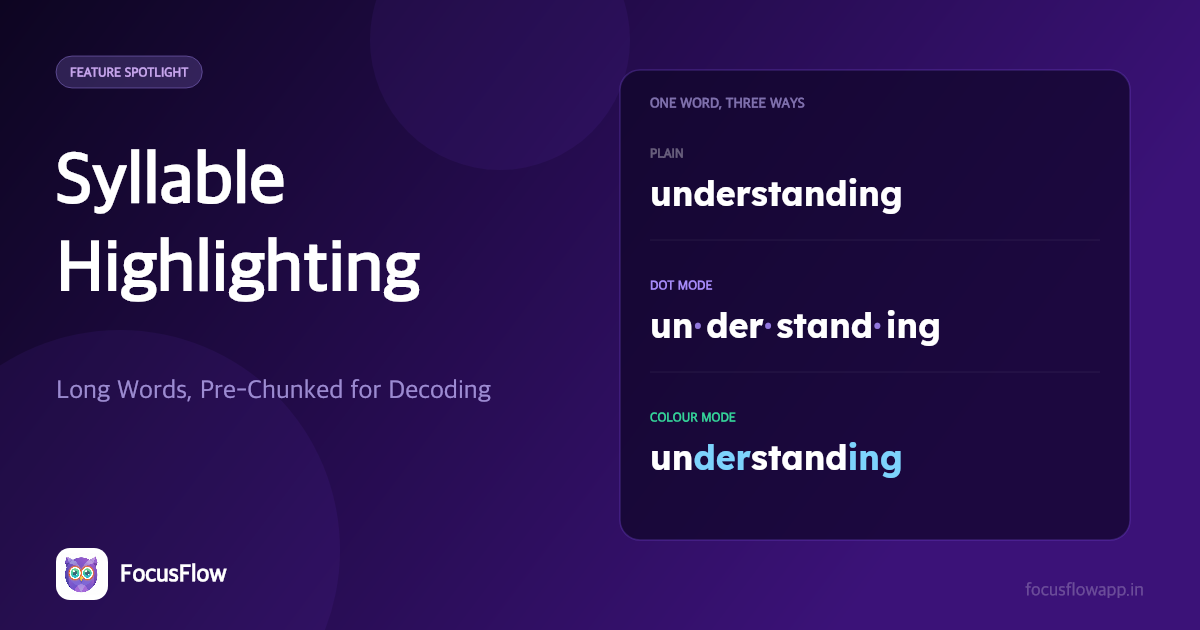
Syllable highlighting solves this by doing the chunking for you. It marks the phonetic boundaries inside long words — un·der·stand·ing — so the word arrives pre-broken into pronounceable pieces instead of as one undifferentiated string of letters.
Why Syllables and Not Prefix Bolding
The better-known version of this idea is bionic-style prefix bolding, which emboldens the first few letters of every word to create artificial "fixation points". It looks scientific and it went viral. The controlled evidence for it is weak, and the effect it does produce looks a lot like novelty — an effect that wears off.
Syllable division has a different pedigree. Breaking a long word into pronounceable chunks is the decoding step a struggling reader already performs manually, and teaching it explicitly is standard practice in structured-literacy instruction. Marking the boundaries does not introduce a new technique; it removes the effort of applying one the reader already knows.
There is also a mechanical difference worth noticing. Prefix bolding splits words at an arbitrary character count, which means the emphasis often falls in the middle of a syllable — un**der**standing cuts across the very boundary you want the eye to find. Syllable marking splits where the word actually divides.
Both are available in FocusFlow. Bionic Reading is free for readers who find it helps, and syllable highlighting is a Pro feature. They are independent toggles, so you can run either, or neither.
How Syllable Highlighting Looks
There are two display modes.
Dot mode (default) inserts a thin middle dot between syllables:
The en·vi·ron·men·tal im·pact of trans·por·ta·tion in·fra·struc·ture re·quires con·sid·er·a·ble in·ves·ti·ga·tion.
Colour mode alternates two text colours across syllables instead, which some readers prefer because it adds no extra characters to the line:
The environmental impact of transportation…
Dot mode is easier to follow for most readers and is the default. Colour mode is worth trying if the dots feel like visual noise, or if you are reading in a narrow column where the extra character width matters.
What You Can Adjust
| Setting | Options | Default |
|---|---|---|
| Mode | Dot separator, or alternating colours | Dot |
| Minimum word length | 4 to 8 characters | 5 |
| Colours | Two tones, each with a custom picker | Dark grey / muted blue |
The minimum word length is the setting that matters most in practice. At the default of 5 characters, short common words are left alone and only the words that actually cost you something get marked. Raise it to 7 or 8 if the page starts to look busy; lower it to 4 if you want every multi-syllable word chunked.
Words that resolve to a single syllable are never marked, however long they are — through stays through.
Where It Does Not Get In The Way
Three details that matter more than they sound:
- Screen readers hear the original word. The separator dots are marked
aria-hidden, so assistive technology readsunderstanding, notun-der-stand-ing. - Copy and paste gives you the original word. The dots are not selectable, so pasting into a document or a search box produces clean text.
- Code is left alone. Text inside
<pre>and<code>is skipped, so syllable marking never mangles a code sample or a command you are about to run.
Turning the feature off restores the page exactly as it was.
How the Syllable Boundaries Are Worked Out
English syllabification is famously irregular, so this is a layered process rather than a single rule:
- An exception dictionary runs first. High-frequency irregular words that rules reliably get wrong —
through,beautiful,environment— have fixed, hand-checked divisions. - One vowel sound per syllable. The vowels are a, e, i, o, u, and y when it is not word-initial.
- Digraphs are never split.
ch,sh,th,ph,wh,ck,ngandquare treated as single consonants. - Standard vowel-consonant patterns apply.
a·boutfor vowel-consonant-vowel,hap·pyfor vowel-consonant-consonant-vowel. - Onset maximisation. The next syllable starts with the longest consonant cluster that can legally begin an English word — which is why it produces
a·pronbutap·ple. - Common suffixes stay whole.
tion,sion,ment,ness,ing,ful,ance,enceandlyare never split across a boundary.
The result is not a phonetician's transcription and does not claim to be. It is a consistent, pronounceable division that matches how the word is taught — which is the part that helps.
Who This Helps
- Readers with dyslexia, particularly anyone who decodes accurately but slowly and stalls on longer words.
- Students meeting subject vocabulary for the first time — scientific, medical and legal terms are mostly long Latinate words, which is exactly the case syllable marking handles best.
- People reading in a second language, where an unfamiliar long word has no stored pronunciation to fall back on.
- Anyone reading dense technical material when tired, when the working memory this feature saves is the resource that ran out first.
It helps less if your difficulty is losing your place between lines — that is what a reading ruler or focus line is for — or if individual letters are hard to tell apart, which is a font problem.
Turning It On
Syllable highlighting is part of FocusFlow Pro. Once Pro is active:
- Popup — click the FocusFlow icon and hit the Syllables tile.
- Sidebar — open Reading → Syllable Highlight for the mode, colours and minimum-word-length controls.
It stacks with everything else: apply an accessible font, widen the line spacing, turn on Reader Mode, and add syllable marking on top. Each one removes a different source of effort.
Frequently Asked Questions
What is syllable highlighting?
Syllable highlighting marks the phonetic boundaries inside long words so they arrive pre-chunked — for example un·der·stand·ing. It scaffolds the decoding step that a struggling reader would otherwise have to perform manually, which is the step that consumes working memory and slows reading down.
Is syllable highlighting better than bionic reading?
They rest on different evidence. Bionic-style prefix bolding emboldens a fixed number of leading letters to create artificial fixation points; the controlled evidence for a reading benefit is weak, and the emphasis often falls mid-syllable. Syllable division is the chunking step used in structured-literacy instruction, so it reinforces a technique readers are already taught. FocusFlow ships both — Bionic Reading free, syllable highlighting as a Pro feature — as independent toggles.
Does syllable highlighting break screen readers or copy and paste?
No. The separator dots are marked aria-hidden and are not selectable, so a screen reader announces the original word and copying the text gives you clean output with no dots in it. Text inside code and pre elements is skipped entirely.
Can I change how syllables are marked?
Yes. There are two modes — a thin dot between syllables, or alternating text colours with a custom picker for each tone — and a minimum word length between 4 and 8 characters, set to 5 by default. Raising the minimum leaves more short words untouched; lowering it marks more of them.
Is syllable highlighting free in FocusFlow?
No, it is a FocusFlow Pro feature. Bionic Reading, reading rulers, colour overlays, Reader Mode, the eight bundled fonts and the full typography controls are all free.