
A line reader is the strip of coloured plastic that sits under the line you are reading and covers what comes next. Classrooms have used them for decades, for a simple reason: for a lot of readers, the hard part is not decoding the words, it is keeping your place.
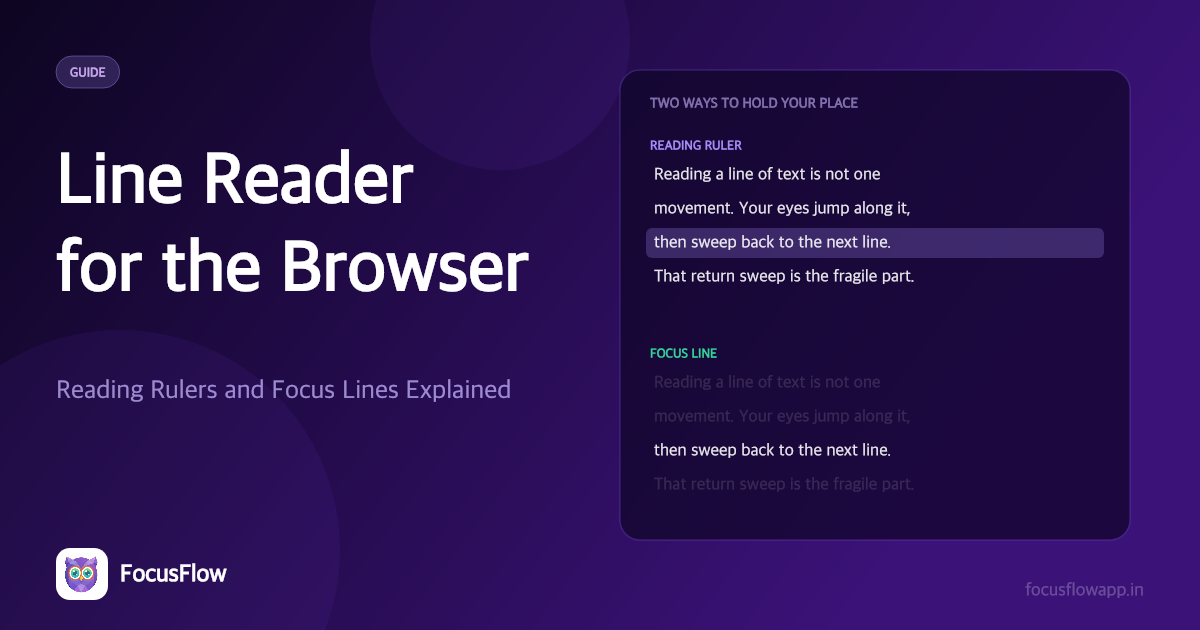
On a screen you cannot lay a piece of plastic over the glass. The browser version is a reading ruler — a coloured band that follows your cursor down the page — or a focus line, which dims everything except the line you are on.
Short answer: install a reading ruler extension, turn it on, and move your mouse down the page as you read. FocusFlow includes both a reading ruler and a focus line for free, on any website.
Why a Line Reader Works
Reading a line of text is not one movement. Your eyes make a series of short jumps along the line, and then one long return sweep back to the start of the next one. That return sweep is the fragile part. Land one line too low and you skip a line. Land one too high and you re-read the one you just finished — usually without noticing until the sentence stops making sense.
Three things make the return sweep harder:
- Long lines. The further your eye has to travel, the more error accumulates. Past roughly 80 characters, accuracy falls off noticeably.
- Tight line spacing. Lines set close together give the eye less margin for error.
- Fatigue. Tiredness degrades eye-movement control directly — which is why you keep re-reading the same sentence late in the day.
A line reader gives the return sweep a target. Instead of aiming at a line among many identical lines, your eye aims at the edge of a coloured band that your own hand is positioning. That is why moving the ruler yourself matters: the hand movement and the eye movement stay in sync.
This helps a much wider group than people often assume — dyslexic readers, readers with ADHD, people with visual stress or Irlen syndrome, people reading dense technical documentation, and anyone reading at the end of a long day.
Reading Ruler vs Focus Line: Which One?
These are two different interventions and they suit different readers.
| Reading ruler | Focus line | |
|---|---|---|
| What it does | Adds a coloured band under the current line | Dims the whole page except a window around the cursor |
| Approach | Marks where you are | Removes everything you are not reading |
| Strength | Gentle; the rest of the page stays readable | Strong; eliminates competing text entirely |
| Best for | Losing your place on the return sweep | Being pulled away by surrounding content |
| Best on | Articles, documentation, long-form text | Busy pages, dense layouts, distracting sites |
If you are not sure, start with the ruler. It is the lighter touch, and you can still see the structure of the page around you. Move to the focus line if the problem is less "where was I" and more "I keep reading the sidebar".
In FocusFlow the two are mutually exclusive — turning one on turns the other off — because running both at once just produces a dim page with a bright stripe on it.
Using the Reading Ruler in FocusFlow
The ruler is a free feature. There are three ways to switch it on:
- Popup — click the FocusFlow icon and hit the Ruler tile.
- Sidebar — open Visual Aids → Reading Ruler for the full set of controls.
- Right-click — FocusFlow → Reading Ruler on any page.
Then move your mouse down the page as you read. The band tracks the pointer's vertical position, so your hand sets the pace.
What you can change:
| Control | Free | Pro |
|---|---|---|
| Colour | 5 palette swatches | Any colour you like |
| Height | 60px | 40 / 60 / 90 / 120px |
| Style | Solid band | Band, guide lines, or gradient |
The free setup — a 60px solid band in one of five colours — is the configuration most people settle on anyway. The Pro controls matter if you need a specific tint for visual stress, or if you prefer thin guide lines bracketing the line rather than a filled band.
Using the focus line
Same three entry points: the Focus Line tile in the popup, Visual Aids → Focus Line in the sidebar, or the right-click menu. The page dims and a clear horizontal window follows your cursor. Free readers get a 60px window; Pro adds a 40px window for tight single-line focus and a 96px one for reading two or three lines at a time.
What to Combine It With
A line reader fixes one specific failure. If reading is still hard with it on, the problem is somewhere else, and these are the other levers worth pulling — all free:
- A colour overlay. A translucent warm tint over the page lowers glare, which is the usual culprit when text seems to shimmer or crawl on a bright white background.
- A dyslexia-friendly font with wider spacing. Crowding and place-keeping are related problems; see the best dyslexia fonts for the web.
- Reader Mode. Stripping out the sidebars, ads and sticky headers shortens the line length and removes the competing text in one step.
- Read-aloud. Following text with your eyes while hearing it is the most effective place-keeping aid there is, because the audio sets the pace instead of your eyes.
The combination that works for most people is Reader Mode + an accessible font + the ruler: short lines, generous spacing, and a marker for where you are.
Other Ways to Get a Line Reader
- A physical reading ruler. Still excellent, still cheap, and works on paper — which a browser extension does not. Worth having if you read print too.
- Your operating system. Windows Magnifier and macOS Zoom can be used as crude reading guides, but they magnify rather than mark, which changes the layout you are reading.
- Reading-ruler features inside apps. Microsoft's Immersive Reader has a line focus feature, and some PDF readers include one. These work only inside that app.
- A browser extension. The only option that works on every website you visit without changing what you read in.
Frequently Asked Questions
What is a line reader?
A line reader is a tool that marks the line of text you are currently reading so your eye can find its way back to it. Physically it is a strip of coloured, often translucent plastic laid across a page. In a browser it is a reading ruler — a coloured band that follows your cursor — or a focus line, which dims everything except a window around the line you are on.
Is there a reading ruler extension for Chrome?
Yes. FocusFlow is a free Chrome extension that includes both a reading ruler and a focus line, alongside dyslexia-friendly fonts, colour overlays, Reader Mode and read-aloud. The ruler can be switched on from the popup, the sidebar, or the right-click menu, and it works on any website.
Do reading rulers actually help?
They help with a specific failure: losing your place on the return sweep from the end of one line to the start of the next. Readers whose difficulty is line-skipping, re-reading or losing their place typically notice the benefit immediately. Readers whose difficulty is decoding individual words are better served by a change of font and spacing, and readers pulled away by surrounding content usually do better with a focus line or Reader Mode.
What is the difference between a reading ruler and a focus line?
A reading ruler adds something — a coloured band under the current line — and leaves the rest of the page visible. A focus line subtracts instead: it dims the entire page except a horizontal window around your cursor. The ruler is the gentler option and suits place-keeping; the focus line is stronger and suits readers who are distracted by surrounding text.
Is the reading ruler free in FocusFlow?
Yes. The reading ruler and the focus line are both free features, with five ruler colours and a 60px height. FocusFlow Pro adds a custom colour picker, four ruler heights, and three ruler styles, but the free configuration is the one most readers settle on.
Can I use a reading ruler on a PDF or in Google Docs?
On a PDF opened in the browser, a ruler that draws over the page will generally work. Google Docs is the exception: it renders your document onto an HTML canvas, so extensions cannot draw inside the document area or restyle its text. For a document you cannot edit, copy the text into the free FocusFlow Online Reader, which has its own reading ruler built in.