
Google Docs is where a lot of reading actually happens — coursework, shared drafts, meeting notes, handouts. If text is hard for you to decode, the default 11pt Arial on a stark white page is close to the worst possible starting point.
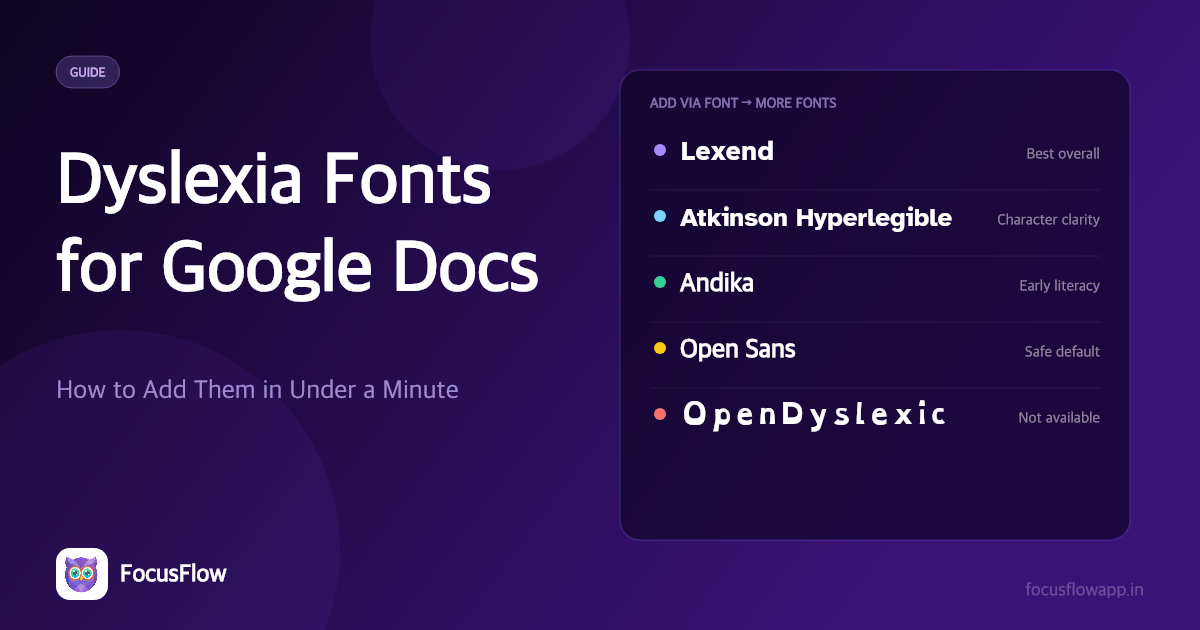
Short answer: open Font → More fonts in Google Docs and add Lexend. It is the strongest research-backed choice, it is in the Google Fonts library that the Docs font menu draws from, and it will not make your document look unusual. Atkinson Hyperlegible and Andika are the next two. OpenDyslexic is not available in Google Docs — the workarounds are below.
The Dyslexia-Friendly Fonts You Can Add to Google Docs
The Docs font picker is backed by the Google Fonts library, so anything in that library can be added to your font list. These are the ones worth adding:
| Font | Why it helps | Best for |
|---|---|---|
| Lexend | Wider horizontal spacing tuned through reading-proficiency research | Most readers; long documents |
| Atkinson Hyperlegible | Every character drawn to look unlike every other character | Confusing I/l/1, O/0, rn/m |
| Andika | Literacy-teaching design; single-storey a and g |
Children, adult literacy, early readers |
| Open Sans | Large x-height, open apertures, generous default spacing | A safe default nobody will object to |
| Comic Neue | Keeps the irregular letterforms of Comic Sans, drops the rest | Readers who get on with Comic Sans |
There is more detail on why each of these works in the best Google Fonts for dyslexia.
How to Add a Dyslexia Font in Google Docs
- Open your document and click the font name box in the toolbar.
- Click More fonts at the top of the dropdown.
- Type the font name —
Lexend,Atkinson Hyperlegible,Andika— into the search box. - Click the font in the left-hand list so it moves to My fonts on the right.
- Click OK. The font now appears in your toolbar dropdown, in every Google Doc on that account.
- Select all your text with Ctrl+A (⌘+A on Mac) and apply it.
To make it the default for new documents: set the font, size and spacing you want on a paragraph, then go to Format → Paragraph styles → Normal text → Update 'Normal text' to match, and then Format → Paragraph styles → Options → Save as my default styles.
The Settings That Matter More Than the Font
Changing the typeface alone leaves most of the benefit on the table. In Google Docs, three more changes do at least as much work:
- Size. Go to 12pt or 14pt. The 11pt default is below the comfortable floor for sustained reading.
- Line spacing. Format → Line & paragraph spacing → 1.5. Line spacing is one of the most reliably helpful adjustments for dyslexic readers, and Docs makes it a two-click change.
- Line length. In File → Page setup, widen the left and right margins to around 1.5 inches, or switch to Pageless and narrow the window. Lines longer than roughly 80 characters make it much easier to lose your place on the return sweep.
Add a soft page colour while you are there — File → Page setup → Page color — and pick a warm off-white or pale cream rather than pure white. Nothing about this is cosmetic: it is the same set of levers described in accessible typography for the web.
OpenDyslexic in Google Docs: What Actually Works
OpenDyslexic is free and open-source, but it is not in the Google Fonts library, so it will never appear under More fonts no matter how you search. Installing it on your computer does not help either — Google Docs renders from its own web font list, not from your system fonts.
That leaves three realistic routes:
- Download and read elsewhere. File → Download → Microsoft Word (.docx) or OpenDocument (.odt), install OpenDyslexic on your machine from opendyslexic.org, and apply it in Word, Pages or LibreOffice — all of which do use your system fonts.
- Paste the text into a reader that bundles it. The free FocusFlow Online Reader lets you paste any text and read it in OpenDyslexic, Lexend, Atkinson Hyperlegible and more, with adjustable size, line height, letter spacing and word spacing — and a reading ruler on top. Nothing to install.
- Check the Workspace Marketplace. Third-party font add-ons for Docs exist, but they appear and disappear over time. If you find one that currently offers OpenDyslexic, it will work; just do not plan a workflow around one being there permanently.
Why Browser Extensions Cannot Restyle Google Docs
This surprises people who already use a reading extension everywhere else. Since 2021, Google Docs draws your document onto an HTML <canvas> element rather than laying it out as text nodes in the page. A canvas is a picture as far as the browser is concerned — there is no paragraph for CSS to target and no text for an extension to re-typeset.
So a browser extension can change the font on almost any website, and then appear to do nothing on Google Docs. That is not a bug in the extension; there is nothing there for it to style. The same applies to Reader Mode.
The practical consequences:
- If it is your document, change the font inside Docs using the steps above.
- If it is someone else's document and you cannot edit it, copy the text into the free online reader and set it up there.
- For everything outside Docs — articles, documentation, research papers, email on the web — an extension is the right tool. FocusFlow applies any of eight bundled typefaces to any page, remembers a different setup per website, and adds a reading ruler, colour overlays and read-aloud on top.
Frequently Asked Questions
What is the best dyslexia font for Google Docs?
Lexend. It is in the Google Fonts library that the Docs font menu draws from, so it takes about fifteen seconds to add, and its wider horizontal spacing targets visual crowding — the barrier with the strongest research behind it. Atkinson Hyperlegible is the better choice if the reader confuses similar-looking characters such as I, l and 1, and Andika is designed for early and returning readers.
How do I add OpenDyslexic to Google Docs?
You cannot add it through the font menu, because OpenDyslexic is not part of the Google Fonts library that Google Docs draws from, and Docs does not use fonts installed on your computer. The reliable workarounds are to download the document as .docx or .odt and open it in Word, Pages or LibreOffice with OpenDyslexic installed, or to paste the text into a reader that already bundles the font, such as the free FocusFlow Online Reader.
How do I change the default font in Google Docs?
Apply the font, size and line spacing you want to a paragraph, then choose Format, Paragraph styles, Normal text, and Update 'Normal text' to match. Then open Format, Paragraph styles, Options, and choose Save as my default styles. Every new document on that account will start with those settings.
Why can't my reading extension change the font in Google Docs?
Google Docs renders your document onto an HTML canvas element rather than as selectable text in the page. To the browser that canvas is effectively an image, so there is no text for CSS or an extension to restyle. This is why a font or Reader Mode extension that works everywhere else appears to do nothing inside a Google Doc.
What line spacing should I use in Google Docs for dyslexia?
Set line spacing to 1.5 from Format, Line and paragraph spacing. Increased line spacing is one of the most consistently helpful typographic adjustments for dyslexic readers, and combined with 12–14pt text and wider margins it usually makes a bigger difference than the choice of typeface.